
Reviewed by Lee Gundenswager (Lead Electrician, Connex Lic #92217) and Darren Standring (Owner). Last updated 2026-08-18.
Emergency lighting looks simple — a few lights that come on when the power fails — but there is a standards-driven system behind it, and understanding how it works helps you keep your building compliant. This guide explains how emergency lighting works, what the test switch does, and which Australian Standards apply, in plain English. Connex Electrical installs, tests and certifies emergency lighting across North Brisbane and Moreton Bay.
How does emergency lighting work?
Every emergency light and illuminated exit sign has its own rechargeable battery built in. During normal operation, mains power keeps that battery topped up. When the mains power fails — a blackout, a tripped main, or a fire cutting the supply — the fitting automatically switches to its battery and illuminates, lighting the escape path and exits so people can get out safely. When power returns, the fitting switches back to mains and recharges the battery, ready for next time. This is called a maintained or non-maintained fitting depending on whether it is also lit during normal use.
What is the test switch?
The test switch is how the system is checked without cutting power to the whole building. Emergency lighting must be tested by simulating a mains failure — and the test switch (or, in modern systems, a central test facility) does exactly that for the emergency lighting circuit only. Flicking it forces the fittings onto battery so the electrician can confirm each one illuminates and stays lit for its full rated duration. In older buildings this is a physical key-switch or test point; in newer buildings it is often an automated central monitoring system that runs and logs the tests itself.
What is a discharge test?
A discharge test is the core of emergency lighting compliance. The fittings are switched to battery and left running for their full rated duration — commonly 90 minutes — to prove the battery can actually last that long in a real emergency. A light that comes on but dies after ten minutes fails the test. Under AS/NZS 2293.2 a full-duration discharge test is required every six months, with every result recorded in the building’s log book.
The Australian Standards, in plain English
- AS/NZS 2293.1 — design and installation. Where fittings go, how many, and how they are wired.
- AS/NZS 2293.2 — inspection and maintenance. The 6-monthly testing regime, the discharge test, and the log book.
- AS/NZS 2293.3 — the fittings themselves. Performance requirements for the emergency luminaires and exit signs.
- National Construction Code (NCC), Part E4 — the law that determines which buildings need emergency lighting and exit signs, based on Class and size.
Together these mean a compliant system is correctly designed (2293.1), uses compliant fittings (2293.3), is required where the NCC says (E4), and is tested and logged every six months (2293.2).
What are the main parts of an emergency lighting system?
- Emergency luminaires — the lights that illuminate the escape path when mains fails.
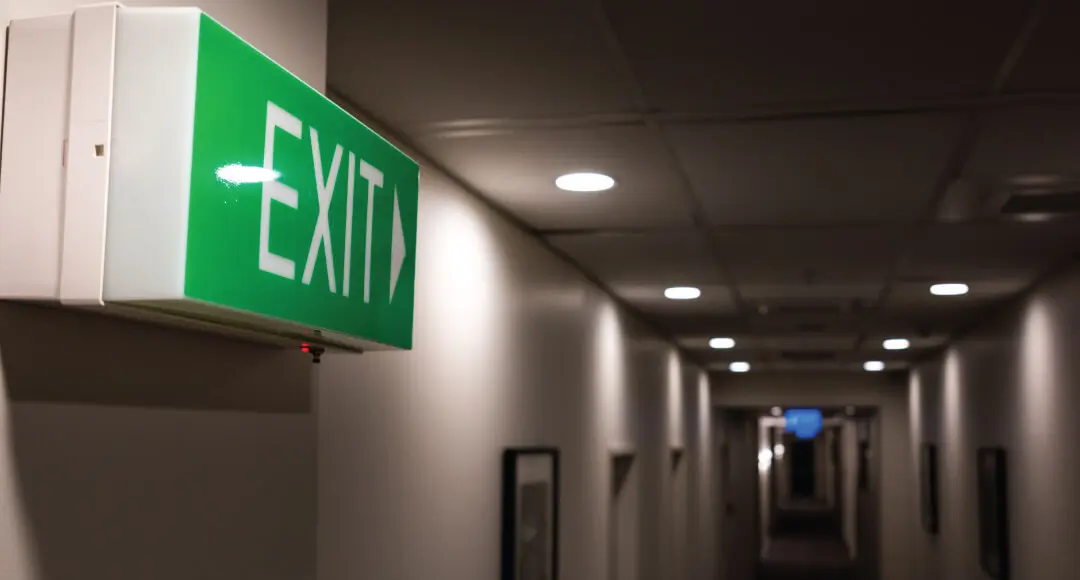
- Exit signs — illuminated running-man or EXIT signs marking the way out.
- Batteries — built into each fitting (or centralised), keeping it lit during an outage.
- Test switch or central monitoring — the means of simulating a mains failure for testing.
- Log book — the record of every test and repair, required to prove compliance.
Why it matters
Emergency lighting only earns its keep in the one moment it is needed — when the lights go out and people have to find their way to an exit. A system that is well designed, uses good fittings and is tested every six months will be ready in that moment. That is the whole point of the standards, and the reason testing is not optional. Connex handles the full lifecycle: design and installation to AS/NZS 2293.1, compliant fittings, and scheduled 6-monthly testing to AS/NZS 2293.2 with full log book records.
Call 0474 207 609 or book online for emergency lighting installation and testing across North Brisbane and Moreton Bay. Licensed QLD Electrical Contractor #92217, $20M public liability, lifetime workmanship guarantee.
How Emergency Lighting Works — Frequently Asked Questions
How does emergency lighting work?
Every emergency light and exit sign has a built-in rechargeable battery kept charged by mains power. When the mains fails, the fitting automatically switches to its battery and illuminates the escape path and exits. When power returns it switches back to mains and recharges, ready for the next outage.
What is a test switch on emergency lighting?
A test switch simulates a mains failure for the emergency lighting circuit only, without cutting power to the whole building. Flicking it forces the fittings onto battery so an electrician can confirm each one lights up and stays lit for its full rated duration. Modern buildings often use an automated central monitoring system instead of a manual key-switch.
What is a discharge test for emergency lighting?
A discharge test switches the fittings to battery and leaves them running for their full rated duration — commonly 90 minutes — to prove the battery lasts that long in a real emergency. A light that dies early fails. AS/NZS 2293.2 requires a full-duration discharge test every six months, recorded in the log book.
What Australian Standards apply to emergency lighting?
AS/NZS 2293.1 covers design and installation, AS/NZS 2293.2 covers inspection and maintenance (the 6-monthly testing), and AS/NZS 2293.3 covers the fittings themselves. The National Construction Code (Part E4) determines which buildings require emergency lighting and exit signs.
What are the main parts of an emergency lighting system?
Emergency luminaires that light the escape path, illuminated exit signs marking the way out, batteries built into each fitting (or centralised), a test switch or central monitoring system to simulate mains failure for testing, and a log book recording every test and repair.
What is the difference between maintained and non-maintained emergency lighting?
A maintained fitting is lit during normal use as well as during a mains failure (common for exit signs). A non-maintained fitting stays off during normal use and only illuminates when the mains fails (common for emergency escape-path lights). Both switch to battery automatically during an outage.